


When Functioning Is Not the Same as Feeling Okay

You wake up tired. You work under pressure. You answer messages, solve problems, handle needs that are not your own, push your feelings aside, and keep going.
From the outside, it looks like you are fine.
You showed up. You got dressed. You met the deadline. You responded. You handled it. You did what needed to be done, even when your body felt heavy and your mind felt crowded.
That is what makes stress so easy to miss. It does not always look like falling apart. Sometimes it looks like being dependable. Sometimes it looks like being the person everyone trusts because you can carry a lot without making noise.
But functioning does not always mean you are okay.
There is a difference between making it through the day and feeling present in your life. There is a difference between handling pressure and recovering from it. There is a difference between being strong and being numb.
At some point, many people stop asking, “How am I really doing?” and start asking, “Can I get through today?”
That shift matters.
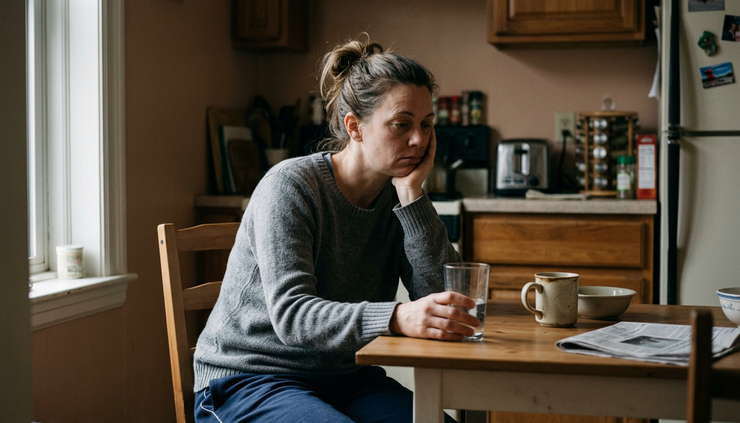
Stress can start to feel like your normal setting
Modern life teaches people to normalize exhaustion.
In a demanding place like New York City, the pace can feel constant. Trains are crowded. Schedules are tight. Everyone seems to be moving quickly, responding quickly, deciding quickly. Even quiet moments can feel interrupted by alerts, noise, errands, conversations, and the pressure to keep up.
Over time, being busy starts to feel normal.
Feeling drained starts to feel normal.
Never having a quiet moment starts to feel normal.
The problem is that “normal” does not always mean healthy. It may only mean familiar.
When stress becomes part of the background, the body and mind adapt. You learn how to keep moving with a tight chest. You learn how to answer messages while feeling overwhelmed. You learn how to smile when you are irritated, how to perform when you are depleted, how to say “I’m good” without checking if it is true.
That kind of adaptation can help you survive a hard season. It can also make it harder to notice when stress is taking more from you than you realize.
You may not call it stress anymore. You may call it life.
A crowded calendar. A short temper. A mind that will not shut off at night. A constant sense that you are behind. A body that feels tired no matter how much you sleep.
When those things become familiar, they can start to feel like personality traits.
“I’m just impatient.”
“I’m just bad at relaxing.”
“I’m just always tired.”
“I’m just wired this way.”
Maybe. Or maybe your system has been carrying more than it was built to carry without pause.
Getting used to stress is not the same as recovering from it
People often confuse endurance with recovery.
Endurance means you can keep going under pressure. Recovery means your body and mind get a chance to settle after that pressure.
Those are not the same thing.
You can become familiar with stress without healing from it. You can learn to tolerate a racing mind, a tense jaw, a shallow breath, and a low-level sense of urgency. You can get so used to pressure that it no longer surprises you, even though it continues to affect you.
Think about a phone running too many apps in the background. It may still work. You can still text, scroll, answer calls, and check your calendar. But the battery drains faster. The screen freezes. The device gets hot. Nothing is technically broken, but everything takes more effort.
People can be like that too.
You may still be doing what needs to be done, but your inner resources may be running low. You may still be kind, focused, and responsible, but with less patience. You may still be showing up for others while slowly disappearing from yourself.
That is why the question is not only, “Can I handle this?”
A better question is, “What is handling this costing me?”
If your only measure of wellness is whether you can keep functioning, you may miss the signs that stress is shaping your life in quiet ways.
Just because you can carry something does not mean it is not heavy.
Productivity can hide how tired you are
Productivity can be misleading because it gives stress a mask.
You can meet every deadline and still be mentally exhausted. You can lead a household, manage work, support family, stay on top of bills, make plans, keep promises, and still feel like there is no space inside your own life.
From the outside, productivity looks like proof that everything is working.
Inside, it may feel different.
You may notice:
Your focus is shorter than it used to be.
Small inconveniences irritate you more than they should.
Rest feels uncomfortable or undeserved.
You feel guilty when you are not being useful.
You need constant distraction to avoid your own thoughts.
You finish the day with nothing left for joy.
None of this means you are failing. It means your capacity is human.
A person can be high-functioning and still be overwhelmed. A person can be responsible and still need rest. A person can be capable and still need care.
The danger is that productivity gets rewarded while recovery gets ignored. People praise the finished work, the fast response, the calm appearance, the ability to juggle everything. Far fewer people ask what it took out of you.
So you learn to keep producing.
Then you learn to treat your needs as interruptions.
You skip the walk because there is more to do. You cut the conversation short because there is another task waiting. You eat quickly, breathe shallowly, sleep lightly, and call it discipline.
But discipline without recovery becomes depletion.

Pushing through has a cost
There are moments when pushing through is necessary. Life rarely pauses just because you are tired. Responsibilities are real. People depend on you. Work has deadlines. Family needs attention. Bills arrive whether you feel centered or not.
The issue is not that you push through sometimes. The issue is when pushing through becomes your only setting.
A body that never gets to downshift stays on alert. A mind that never gets quiet starts treating everything like a demand. Over time, small things can feel heavier because there is no buffer left.
The cost may show up in subtle ways.
You become less patient with people you love.
You reread the same sentence five times because your focus will not hold.
You feel flat during moments that should feel good.
You find yourself snapping, withdrawing, overthinking, or reaching for any distraction that offers relief.
You may not connect these signs to stress because nothing dramatic has happened. There may be no major crisis. No obvious breakdown. No clear moment where you can say, “This is when it became too much.”
That is how chronic stress often works. It does not always arrive loudly. It builds through repetition.
Another packed day.
Another ignored feeling.
Another night of poor rest.
Another morning of telling yourself to keep going.
The body keeps score in ordinary ways. Tight shoulders. Shallow breathing. headaches from tension. A stomach that reacts to pressure. A mood that changes quickly. A sense that you are always bracing for something.
This content is informational and not medical advice. If stress feels unmanageable, persistent, or tied to anxiety, depression, trauma, or physical symptoms, support from a qualified health professional can matter.
Still, there is value in noticing early. You do not have to wait until you are burned out to make a change.
You do not need to collapse before you recover
Many people wait for a breaking point before they give themselves permission to rest.
They wait until exhaustion becomes undeniable. They wait until their body forces them to stop. They wait until they cannot focus, cannot sleep, cannot feel connected, cannot enjoy anything.
But recovery should not require a crisis.
Small moments matter before things become overwhelming. A few minutes outside. A slower morning routine. A real meal without rushing. A walk without headphones. A pause before answering a message. A breath that is deeper than the last ten.
These moments may seem too small to matter, especially when life feels big and demanding. But patterns are built through repetition, and they can be interrupted through repetition too.
You do not need to change your whole life in one day. You can start by creating small spaces where your nervous system is not being asked to perform, respond, or defend.
That might look like:
Sitting in silence for two minutes before checking your phone.
Taking three slower breaths before walking into a difficult conversation.
Letting yourself feel tired without immediately judging it.
Noticing where your body is tense and softening what you can.
Ending the day with one quiet ritual that does not involve a screen.
These are not escapes from responsibility. They are ways of returning to yourself within responsibility.
Wellness is often misunderstood as something soft, optional, or separate from real life. But wellness is part of being able to handle life without letting it consume every part of you.
Rest does not make you less committed.
Breathing does not make you less capable.
Pausing does not mean you are giving up.
Sometimes the most responsible thing you can do is stop treating your own depletion as the price of being dependable.

Human Powered breathwork helps create a few minutes of space
Stress often runs on automatic patterns.
A tense email comes in, and the body tightens.
A train delay happens, and the mind jumps ahead to everything that could go wrong.
Someone says something sharp, and the nervous system prepares to fight, defend, explain, or shut down.
These reactions can happen before you have time to think. That does not mean you are weak. It means your body is trying to protect you based on what it has learned.
Human Powered breathwork offers a simple way to interrupt that automatic loop.
Breathwork does not erase responsibility. It does not remove hard conversations, deadlines, grief, financial pressure, or the realities of living in a demanding world. It should not be treated as a cure for stress or a replacement for professional support when that is needed.
What it can do is create space.
When you deliberately slow your breathing, even briefly, you send yourself a different signal. Instead of staying locked in urgency, you create a moment where you can notice what is happening inside you.
You may notice the jaw you have been clenching.
You may notice that your shoulders have been lifted all afternoon.
You may notice that you are reacting from fear, not clarity.
You may notice that you have been holding your breath through the entire day.
That awareness matters because it gives you a choice. Maybe not a perfect choice. Maybe not an easy one. But a choice all the same.
You can respond instead of snap.
You can pause instead of rush.
You can name what you feel instead of burying it.
You can step away from constant stimulation and remember that you are more than the pressure around you.
A Human Powered breathwork practice can be as simple as taking a few minutes to sit, breathe slowly, and let the body experience a break from input. No performance. No need to do it perfectly. No pressure to become instantly calm.
Just a few minutes where the goal is not to produce, prove, or push.
That may sound small. In a culture that rewards constant output, small can feel almost radical.
Ask whether you are managing stress or only living with it
There is a hard question worth asking with honesty:
Have you learned to manage stress, or have you only learned to live with it?
Managing stress means you have ways to recover, reset, communicate, and notice your limits. Living with stress means you keep adapting to the pressure while calling the pressure normal.
One creates more capacity over time. The other can quietly drain it.
This question is not meant to create shame. Most people are doing the best they can with full schedules, real demands, and little permission to slow down. For many, pushing through was not a choice at first. It was survival. It was how they got through school, work, caregiving, loss, uncertainty, or years of being needed.
The point is not to criticize the ways you survived.
The point is to ask whether those same patterns are still serving you.
Maybe being able to handle everything has become part of your identity. Maybe you are the reliable one, the calm one, the strong one, the person who figures it out.
Strength is valuable. But strength without softness can become a cage.
You are allowed to need quiet. You are allowed to need support. You are allowed to admit that something affects you, even if you can still function while carrying it.
You do not have to prove your stress is real by reaching a breaking point.

A different way to measure strength
What if strength also meant noticing sooner?
Noticing that your patience is thinner.
Noticing that joy feels harder to access.
Noticing that your body is asking for rest before it has to demand it.
Noticing that constant pressure has become familiar, but familiar does not mean harmless.
That kind of noticing is not weakness. It is self-respect.
A few minutes of breathwork will not solve every problem. It can give you one honest moment with yourself. One pause in the middle of noise. One chance to interrupt the pattern of ignoring your own signals.
That is where change often begins.
Not with a dramatic life overhaul. Not with quitting everything and starting over. Not with waiting until you have no choice.
It begins when you stop mistaking endurance for wellness.
It begins when you admit that being able to carry stress does not mean stress is not affecting you.
It begins when you give yourself permission to recover, not because you have earned it by burning out, but because you are human.


Comments