.png)
You’re Not Lazy Youre Mentally Overloaded

You wake up tired before the day even starts.
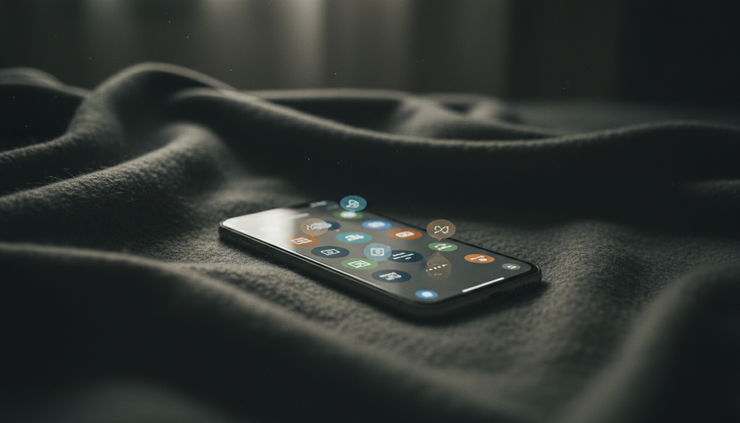
The alarm goes off. You grab your phone before your feet hit the floor. There are messages, headlines, missed notifications, a few things you forgot to answer, and one email that should not be there yet. You check one app, then another. You tell yourself it will take two minutes. Ten minutes later, your brain already feels crowded.
Then the day begins.
You make coffee while thinking about work. You start one task, remember another, open a tab, answer a text, check the weather, see a news alert, reply to someone, forget what you opened the tab for, then feel that low-grade pressure build in the back of your head.
Nothing dramatic happened. You did not run a marathon. You did not dig a trench. You barely moved.
Still, by the end of the day, you feel wiped out.
That is where a lot of people make the wrong call. They assume they are lazy. They assume they need more discipline, more drive, more motivation, more willpower. Maybe that is true sometimes. Sometimes you do need to get up and do the thing.
But there is another possibility.
You may not be lazy. You may be mentally overloaded.

The problem is not always doing too much
Most people understand physical exhaustion. If someone spends all day carrying boxes, fixing a roof, working a long shift, or training hard, it makes sense when they are tired.
Mental exhaustion is harder to defend.
You can sit in a chair all day and still feel fried. You can have a mostly normal day and still feel like your head is full of static. You can look productive from the outside and be barely holding a straight line on the inside.
That does not mean something is wrong with you.
It means your brain has been processing all day.
Processing messages. Processing decisions. Processing other people’s moods. Processing bills, deadlines, plans, timelines, errands, family needs, random comments, news clips, unfinished work, and all the small open loops nobody else can see.
Then, when there is a quiet moment, you fill it.
You reach for the phone in line at the store. You play a video while eating. You scan headlines in the bathroom. You answer texts between tasks. You listen to a podcast while walking. You check notifications during commercials. You scroll before sleep.
The empty space disappears.
That is the part people miss. The brain rarely gets a clean break anymore. Quiet does not stay quiet for long. Any gap gets plugged with more input.
A spare minute becomes a screen.
A slow walk becomes audio.
A meal becomes content.
A pause becomes checking.
Then people wonder why they cannot focus.
They blame character. They blame work ethic. They blame a lack of hunger.
Sometimes the real issue is simpler and more uncomfortable: there is no room left.
Mental overload can look like laziness
Laziness has a certain feel to it. You do not care. You do not want to move. The task matters, but not enough to pull you in. There is no tension there.
Mental overload feels different.
You care, but you cannot start. You want to focus, but your attention keeps splitting. You open the laptop and stare. You walk into a room and forget why. You avoid simple tasks because even simple tasks feel like one more demand.
That is not always a motivation problem. It can be a capacity problem.
A phone with too many apps running does not slow down because it is broken. It slows down because too much is happening at once. Music is playing. Maps is tracking. Messages are coming in. The browser has twenty tabs open. Some app in the background keeps refreshing. The battery drains faster, the screen lags, and everything takes longer.
The fix is not yelling at the phone.
You close some apps. You stop the background noise. You let it cool down. You give it less to handle.
People are not phones, but the analogy holds up in one useful way. When there is too much running in the background, performance drops. Focus gets weaker. Patience gets shorter. Small problems feel bigger. Decisions feel heavier. Even rest stops feeling restful because the input never really ends.
That is why a person can spend an entire day “not doing much” and still feel like they got hit with a bag of wet cement.
They were doing plenty.
They were receiving, sorting, filtering, responding, remembering, worrying, planning, comparing, reacting, and bracing.
That work does not always show up on a calendar.
Constant input trains the mind to stay jumpy
Attention is not just something you have. It is something you spend.
Every notification asks for a piece of it. Every unfinished task keeps a piece of it. Every argument you replay, every headline you absorb, every message you need to answer, every responsibility waiting in the background takes a cut.
The strange part is that much of this feels normal now.
Checking the phone while watching a show feels normal.
Reading comments while waiting for food feels normal.
Working with ten tabs open feels normal.
Jumping from message to email to task to video feels normal.
Carrying five unfinished thoughts at once feels normal.
Normal does not mean harmless.
The modern day is built to keep feeding you something. A ping. A preview. A short clip. A new opinion. A small emergency. A thing you should buy. A person you should respond to. A problem you should care about. A reminder of what you have not finished.
No single piece feels that heavy. The weight comes from the stack.
This is why the advice to “just be more disciplined” can feel insulting. Discipline matters, but it cannot do its job when the system is flooded. If your attention is being pulled in ten directions before breakfast, telling yourself to focus harder may only add one more demand.
There is a difference between being weak and being overloaded.
One needs a push.
The other needs subtraction.
The reset is smaller than people make it
A reset does not need to be dramatic. It does not need a retreat, a perfect morning routine, a cold plunge, a new app, or a full personality change.
It can be blunt and simple.
Put the phone down.
Step outside without headphones.
Sit for three minutes without adding anything.
Take a walk without turning it into content time.
Let a meal be just a meal.
Drive without filling the car with noise.
Close the extra tabs.
Write down the open loops instead of carrying them all in your head.
None of this magically fixes your life. It does not erase responsibilities. It does not pay bills, answer emails, or solve every problem waiting for you.
But it can create a gap.
That gap matters.
A few slower breaths are not a cure-all. Breathing does not make you invincible. It does not turn chaos into order by itself. But slowing the breath for a minute can interrupt the reflex to keep reacting. It gives you a small space between input and response.
That space is where you can ask a better question.
Do I actually need to check this right now?
Am I tired, or am I full?
What am I carrying that I have not put down once today?
What would happen if I stopped feeding the noise for five minutes?
The point is not to become calm all the time. That is not real life. The point is to stop treating every empty second like it needs to be filled.

Less input can do what motivation cannot
Motivation is useful when the path is clear and the load is reasonable.
But when your mind is jammed with input, motivation often becomes another thing you chase. You look for the right video, the right quote, the right playlist, the right plan, the right burst of energy.
That can turn into more consumption.
More information. More advice. More noise. More tabs open in the background. More pressure to become the kind of person who never gets tired.
The cleaner move may be to remove something.
Cancel the noise for a few minutes. Stop checking the thing you already checked. Do one task without bouncing. Let a thought finish before grabbing another. Give your attention one target instead of twelve.
This is not about becoming a minimalist monk. It is about being honest about the cost of constant input.
If you feel drained every day, look at what you are asking your mind to carry. Not just the work. The intake.
The headlines.
The group chats.
The half-finished conversations.
The tabs.
The reminders.
The clips.
The arguments online.
The pressure to respond fast.
The private worries no one sees.
The responsibilities that follow you from room to room.
You may be calling yourself lazy when the better word is loaded.
And loaded things handle differently.
Ask what you have been carrying
Before you decide you are lazy, take a harder look at the day.
How many times did you switch tasks?
How many things asked for your attention?
How many conversations did you replay?
How many alerts did you answer?
How much noise did you add when silence showed up?
How many unfinished thoughts followed you around?
Then ask the question most people skip.
What have I been carrying all day without giving myself a chance to put down?
That question will tell you more than another motivational video.
You do not always need more motivation. Sometimes you need less input. Less noise. Less grabbing. Less reacting. Less background pressure. Less of the stuff that keeps your mind running even when your body is still.
Sometimes the reset isn't doing more. It's finally giving yourself less to process.


Comments